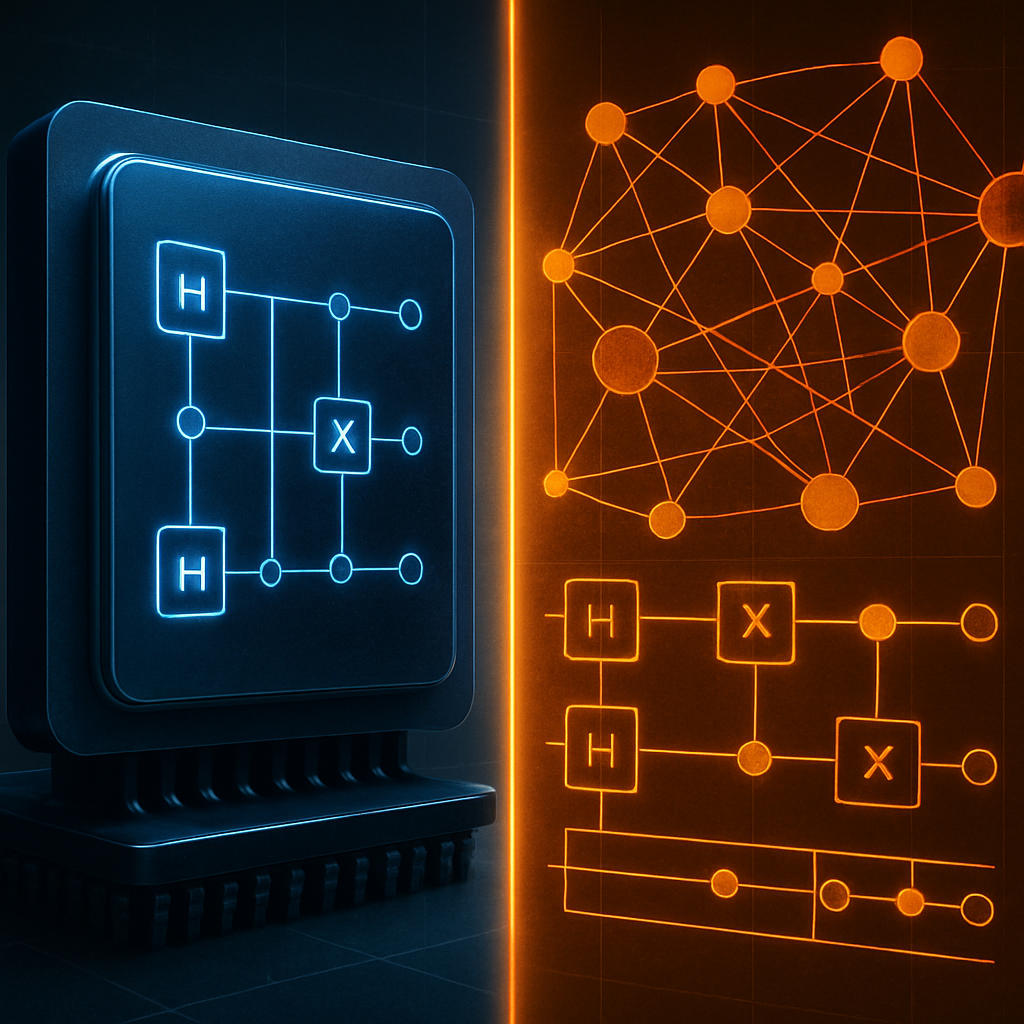
Key Takeaways
- Qiskit is IBM's open-source quantum SDK, optimized for gate-level circuit construction and deep integration with IBM Quantum hardware.
- PennyLane, built by Xanadu, uses a differentiable programming model that treats quantum circuits as machine learning layers — ideal for hybrid quantum-classical research.
- PennyLane supports 20+ backends including IBM, Google, and AWS; Qiskit natively targets IBM Quantum devices but can be extended via plugins.
- For quantum machine learning and variational algorithms like VQE and QAOA, PennyLane offers a measurable developer experience advantage through autograd-compatible gradients.
- Qiskit's ecosystem — including Aer, Runtime primitives, and transpilation tooling — provides production-grade noise modeling essential for hardware research.
- The optimal 2026 strategy for most developers: learn Qiskit for hardware-level work, and PennyLane for quantum ML and multi-backend portability.
Why the Qiskit vs PennyLane Decision Matters
Choosing the wrong quantum SDK can cost you weeks of painful refactoring and silently lock your research into a single hardware vendor. The quantum software landscape in 2026 has matured considerably, but the two frameworks that consistently dominate developer conversations are Qiskit and PennyLane. They are not interchangeable — they reflect fundamentally different philosophies about what quantum programming should look like.
Qiskit, maintained by IBM, was designed from the ground up to give developers precise, low-level control over quantum circuits and direct access to IBM Quantum hardware. PennyLane, developed by the Canadian startup Xanadu, took a radically different approach: it treats quantum circuits as differentiable functions, making them composable with classical machine learning frameworks like PyTorch and JAX. Understanding where each framework excels — and where it falls short — is the first step toward writing quantum code that actually ships.
Architecture and Core Philosophy
Qiskit: Gate-Level Precision and Hardware Fidelity
Qiskit's architecture is built around a modular stack. At its core, Qiskit Terra handles circuit construction, transpilation, and backend communication. Qiskit Aer provides high-performance classical simulation with configurable noise models that closely mirror real IBM Quantum hardware. The Qiskit Runtime layer, introduced in recent years and now the standard execution model in 2026, abstracts repetitive quantum-classical loops into efficient server-side primitives called Sampler and Estimator.
This layered design means that a Qiskit developer can start with a noiseless statevector simulation, profile circuit depth and gate counts with the transpiler, apply a realistic noise model in Aer, and then submit to real hardware — all within the same codebase. The framework rewards developers who want to understand what is happening at the physical qubit level. If you need to decompose a multi-controlled gate into native basis gates for a specific device topology, Qiskit's transpilation pipeline gives you the knobs to do it.
PennyLane: Differentiable Quantum Programming
PennyLane's central innovation is the concept of a quantum node, or QNode. A QNode wraps a quantum circuit function and makes it differentiable — meaning you can compute gradients of quantum circuit outputs with respect to their parameters using the same automatic differentiation engines that power modern deep learning. This is not a cosmetic feature; it fundamentally changes how you build variational algorithms.
In PennyLane, a hybrid quantum-classical model looks structurally identical to a neural network layer. You define a circuit, wrap it in a QNode, and pass it to an optimizer like torch.optim.Adam or optax without any custom gradient plumbing. PennyLane computes parameter-shift rule gradients or adjoint differentiation natively, depending on the backend. This design philosophy makes it the natural home for quantum machine learning research, where the training loop is the central abstraction.
Hardware Support and Backend Flexibility
Backend flexibility is one of the sharpest practical differences in the Qiskit vs PennyLane comparison. PennyLane supports more than 20 hardware and simulator backends through a plugin ecosystem that includes IBM Quantum (via pennylane-qiskit), Google's Cirq-based devices, Amazon Braket, Rigetti, IonQ, and Xanadu's own photonic hardware. This means a PennyLane circuit written today can, in principle, run on superconducting, trapped-ion, or photonic hardware with minimal code changes — just swap the device string.
Qiskit, by contrast, is natively optimized for IBM Quantum devices. While community plugins exist to target other hardware, the first-class experience — including Runtime primitives, dynamic circuits, and real-time classical control — is exclusive to IBM's cloud platform. This is not necessarily a weakness: IBM Quantum is one of the most accessible and feature-rich quantum cloud platforms available in 2026, with systems exceeding 100 qubits and new error-correction experiments underway. But if your research agenda requires hardware-agnostic code or you need to benchmark across multiple vendors, PennyLane's multi-backend design is a genuine advantage.
Quantum Machine Learning and Variational Algorithms
PennyLane's Native Advantage
For quantum machine learning (QML) tasks — training variational quantum eigensolvers (VQE), quantum approximate optimization algorithms (QAOA), quantum neural networks, or quantum kernel methods — PennyLane is the more ergonomic choice in 2026. Its gradient computation is seamlessly integrated: you can differentiate through a quantum circuit with a single call to qml.grad, or let PyTorch or JAX handle the backward pass automatically when a QNode is used as a layer inside a larger model.
PennyLane also ships with pennylane.templates, a library of pre-built variational ansätze including StronglyEntanglingLayers, BasicEntanglerLayers, and data-encoding circuits like AngleEmbedding and AmplitudeEmbedding. These templates dramatically reduce boilerplate for common QML workflows. The framework's qml.qnn module provides Keras and Torch layer wrappers, letting you drop a quantum circuit into a classical deep learning pipeline with three lines of code.
Qiskit's Variational Toolkit
Qiskit is not without variational algorithm support. The Qiskit Algorithms library provides implementations of VQE, QAOA, and quantum phase estimation that integrate directly with Qiskit Runtime's Estimator primitive. For hardware experiments where noise mitigation matters — zero-noise extrapolation, probabilistic error cancellation, or Pauli twirling — Qiskit's tight coupling to IBM hardware gives it access to calibration data and error rates that third-party frameworks simply cannot replicate.
However, Qiskit's gradient computation story is less seamless than PennyLane's. Computing parameter-shift gradients in Qiskit requires more explicit setup, and integrating with PyTorch or JAX training loops demands additional glue code. For pure research prototyping where the training loop is the focus, many developers find PennyLane's interface significantly faster to work with.
Simulation Performance and Noise Modeling
When it comes to classical simulation, Qiskit Aer is one of the most capable quantum simulators available as an open-source tool. Aer supports multiple simulation methods: statevector, density matrix, stabilizer (for Clifford circuits), matrix product state (MPS) for low-entanglement circuits, and the unitary simulator. Crucially, Aer's noise modeling system lets you import device noise models directly from IBM Quantum backends, giving you a realistic preview of how your circuit will behave on real hardware before you spend any quantum credits.
PennyLane's default simulators — default.qubit and the JAX-accelerated default.qubit.jax — are clean and fast for small-to-medium circuits, but they lack Aer's depth in noise modeling. PennyLane can use Aer as a backend via the pennylane-qiskit plugin, which is a reasonable workaround, but it adds a dependency and some friction. For developers whose primary concern is accurate noise simulation and hardware characterization, Qiskit's native tooling is the stronger choice.
Developer Experience and Learning Curve
Community Size and Learning Resources
In the Qiskit vs PennyLane debate, community size currently favors Qiskit by a significant margin. IBM has invested heavily in education: the IBM Quantum Learning platform hosts hundreds of tutorials, the open-source Qiskit Textbook covers quantum computing from first principles, and Qiskit questions dominate quantum computing threads on Stack Overflow and Reddit. For CS students and newcomers to the field, this wealth of structured learning material makes Qiskit the lower-risk onboarding choice in 2026.
PennyLane's documentation is excellent and its Quantum Machine Learning demos page is one of the best collections of practical QML tutorials on the internet. But the community is smaller, Stack Overflow coverage is thinner, and finding answers to niche questions sometimes requires digging into GitHub issues. That said, PennyLane's API is arguably more Pythonic and intuitive for developers coming from a machine learning background — the learning curve is steep in quantum mechanics, not in the framework itself.
Installation and Getting Started
Both frameworks install cleanly via pip. pip install qiskit and pip install pennylane will get you a working environment in minutes. Qiskit's modular structure means you may need additional packages — qiskit-aer for simulation, qiskit-ibm-runtime for cloud access — but each package is well-documented. PennyLane's plugin system is similarly modular: install pennylane-qiskit to access IBM backends, or amazon-braket-pennylane-plugin for AWS.
For hardware access, both frameworks require cloud accounts. IBM Quantum offers free tier access to several real quantum systems, which is a meaningful advantage for students and independent researchers who cannot afford paid cloud compute. Xanadu's cloud platform provides access to PennyLane-compatible photonic hardware, though availability and qubit counts differ significantly from superconducting systems.
When to Choose Qiskit
Qiskit is the right choice when your work centers on hardware-level quantum computing. If you are studying quantum error correction, characterizing device noise, optimizing circuit depth for a specific IBM Quantum topology, or building production workflows that rely on Qiskit Runtime's server-side execution, Qiskit gives you capabilities that no other framework matches. It is also the better choice for educators and students working through structured quantum computing curricula, given the depth of available learning resources.
Researchers working on quantum chemistry simulations using tools like Qiskit Nature, or combinatorial optimization using Qiskit Optimization, will find mature, well-tested implementations that integrate naturally with the rest of the Qiskit ecosystem. These domain-specific libraries represent years of community investment and are difficult to replicate in other frameworks.
When to Choose PennyLane
PennyLane is the right choice when your work is fundamentally about quantum machine learning, hybrid optimization, or hardware-agnostic research. If you are training variational circuits, building quantum-classical hybrid models, or benchmarking algorithms across multiple hardware backends, PennyLane's differentiable programming model and plugin ecosystem will save you substantial development time. Its seamless integration with PyTorch, TensorFlow, and JAX makes it the natural SDK for ML researchers entering the quantum space.
PennyLane is also the better choice if your team already has deep ML engineering expertise and wants to apply that knowledge to quantum problems without learning an entirely new programming paradigm. The QNode abstraction maps directly onto concepts like layers, forward passes, and gradient descent that ML engineers already understand intuitively.
The Case for Using Both
The most pragmatic answer to the Qiskit vs PennyLane question in 2026 is: use both. The frameworks are not mutually exclusive, and the pennylane-qiskit plugin means you can write PennyLane circuits and execute them on IBM Quantum hardware via Qiskit Runtime. Many research groups maintain Qiskit-based pipelines for hardware characterization and noise modeling, while running their variational algorithm experiments through PennyLane for the gradient computation ergonomics.
Learning Qiskit first gives you a deep understanding of quantum circuit mechanics, transpilation, and hardware constraints that will make you a better quantum programmer regardless of which framework you ultimately use day-to-day. Adding PennyLane to your toolkit then unlocks the full landscape of quantum machine learning research and multi-vendor hardware access. The two hours spent installing and running a basic PennyLane demo after learning Qiskit is one of the highest-return investments a quantum developer can make in 2026.
Conclusion: Choose Your Quantum Path
The Qiskit vs PennyLane decision is ultimately a question of research goals, not framework quality — both are excellent, actively maintained, and production-ready in 2026. Choose Qiskit if your priority is hardware-level control, IBM Quantum integration, noise modeling, or structured learning with rich community support. Choose PennyLane if your priority is quantum machine learning, differentiable programming, or the freedom to run the same algorithm on a dozen different backends without rewriting your circuit logic.
For most serious quantum developers, the answer is not either/or. The frameworks complement each other in ways that reward developers who invest time in both. Start with the one that aligns with your immediate project, build intuition for the other, and you will be positioned to tackle the full spectrum of quantum computing challenges — from low-level hardware research to cutting-edge quantum AI. The quantum revolution is not waiting, and neither should you. Explore quantum — the best time to start is now.