Key Takeaways
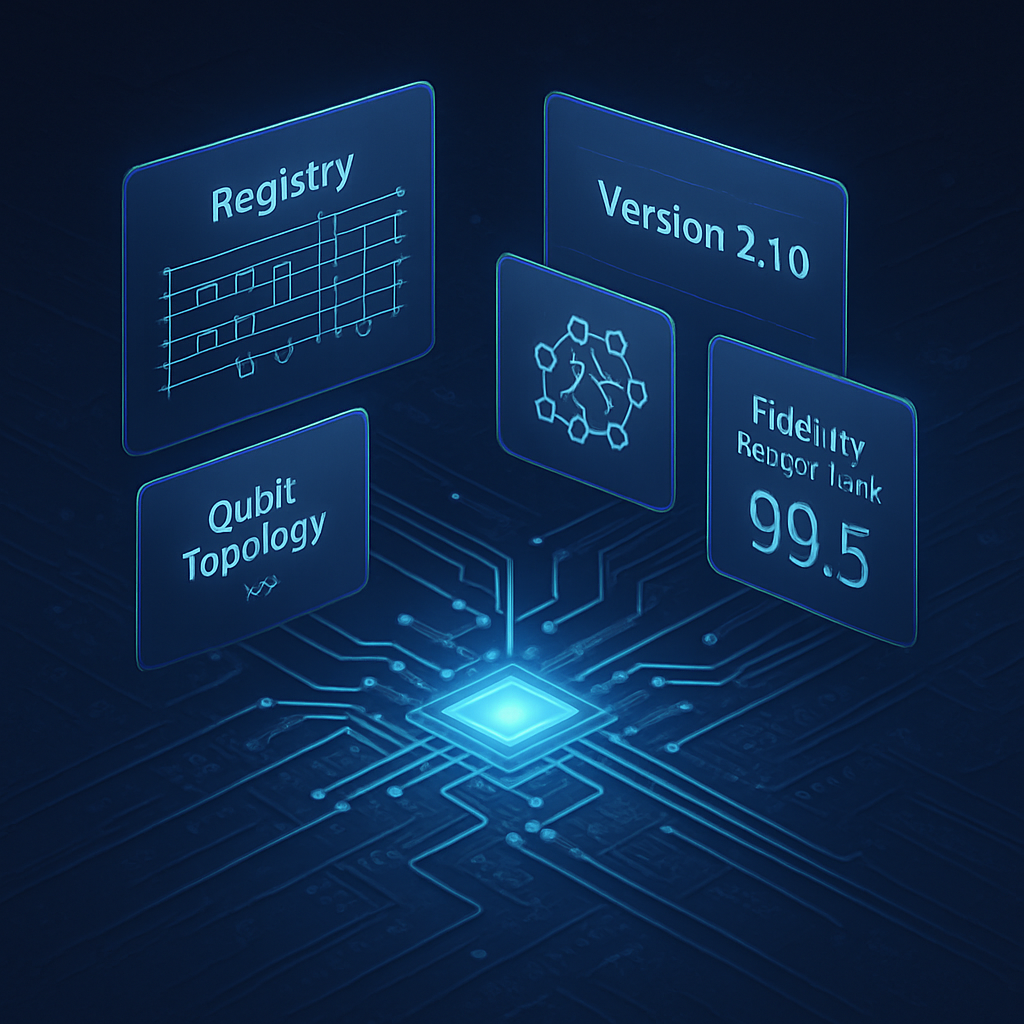
- A quantum circuit registry is a version-controlled repository for storing, sharing, and importing reusable quantum circuit components across teams and platforms.
- Unlike classical package managers, quantum registries must encode qubit topology, gate fidelity metadata, and hardware-specific transpilation constraints.
- Platforms like Qiskit and Cirq are developing native registry-like ecosystems, with community-driven circuit catalogs growing alongside them.
- OpenQASM 3.0 and Quantum Intermediate Representation (QIR) are emerging as the interoperability standards that make cross-vendor circuit registries possible.
- Circuit versioning in quantum registries is uniquely complex — even a single gate substitution can break entanglement structure and algorithmic correctness.
- Quantum circuit registries dramatically improve research reproducibility by replacing ambiguous pseudocode with exact, executable circuit definitions.
Why Quantum Developers Need a Circuit Registry
Most quantum developers waste hours hunting for reusable circuit components that already exist. A quantum circuit registry changes everything — think of it as npm for quantum gates, but with superposition baked in. Just as classical software development was transformed by centralized package registries like PyPI and npm, quantum computing is reaching the point where ad hoc circuit sharing via GitHub repositories and paper appendices is no longer sustainable.
The quantum software ecosystem in 2026 is growing rapidly. IBM's Qiskit community alone has hundreds of thousands of registered users, and platforms like Google's Cirq and Xanadu's PennyLane are attracting serious research and enterprise adoption. Yet the tooling for discovering, reusing, and versioning quantum circuit components has lagged far behind the hardware progress. A well-designed quantum circuit registry directly addresses this gap by providing a single, authoritative source of truth for circuit components — complete with metadata, versioning history, and hardware compatibility information.
What Is a Quantum Circuit Registry?
A quantum circuit registry is a centralized repository system where developers can publish, discover, version, and import modular quantum circuit components. At its core, it functions similarly to a classical software package registry: a developer publishes a circuit module with a semantic version number, a manifest file describing its dependencies and requirements, and documentation explaining its purpose and usage. Other developers can then search the registry, resolve dependencies, and import the circuit into their own projects with a single command or API call.
However, the analogy to classical registries only goes so far. A Python package on PyPI is largely hardware-agnostic — it runs on any machine that supports the Python interpreter. A quantum circuit is inherently tied to physical hardware constraints. The number of qubits required, the native gate set of the target backend, the connectivity graph of the quantum processor, and the noise characteristics of specific gate operations all determine whether a circuit can run correctly on a given device. A robust quantum circuit registry must capture all of this information in its metadata layer.
Core Components of a Registry Architecture
A production-grade quantum circuit registry typically consists of four main components. The circuit store holds serialized circuit definitions in a standard format such as OpenQASM or QIR. The metadata index stores structured information about each circuit, including qubit count, gate depth, supported backends, and benchmark fidelity scores. The versioning engine tracks changes to circuit definitions over time, enabling semantic versioning and dependency resolution. Finally, the transpilation layer optionally handles hardware-specific compilation, converting a generic circuit definition into an optimized form for a specific quantum processor.
Some registries also incorporate a simulation sandbox — a lightweight circuit simulator that validates a submitted circuit before it is published, checking for obvious errors like uninitialized qubits or invalid gate sequences. This is analogous to the CI/CD pipelines that classical package registries use to run tests before accepting a new package version.
How Quantum Circuit Registries Differ from Classical Package Managers
The differences between a quantum circuit registry and a classical package manager go deeper than syntax. Classical software libraries are composed of functions and data structures that are deterministic and hardware-independent. Quantum circuits are probabilistic, hardware-dependent, and subject to decoherence — meaning that a circuit that performs correctly on one quantum processor may produce garbage results on another, even if both processors nominally support the same gate set.
This introduces a class of registry challenges that simply do not exist in classical software. Qubit topology constraints are one major example. Many quantum processors use a limited connectivity graph — qubits can only interact directly with their nearest neighbors. A circuit designed for a fully connected topology must be transpiled, often at significant depth cost, before it can run on a sparse-connectivity device. A well-designed registry encodes the assumed topology and flags incompatibilities before a developer even attempts to run a circuit.
Gate Fidelity Metadata and Noise Models
Gate fidelity is another dimension that classical package managers never need to consider. Every quantum gate operation introduces some probability of error, and these error rates vary across different qubit pairs on the same processor, across different processors from the same vendor, and across time as hardware calibration drifts. A quantum circuit registry that includes gate fidelity metadata allows developers to make informed decisions about which circuit implementations are likely to perform best on their target hardware.
Noise model assumptions are closely related. A circuit that was benchmarked under an optimistic noise model may perform poorly in a real deployment environment. Leading registries in 2026 are beginning to include noise model provenance — specifying exactly which noise model was used during benchmarking, whether it was an idealized depolarizing noise model or a device-specific model derived from actual hardware calibration data. This level of transparency is essential for research reproducibility and production reliability alike.
The Quantum Circuit Registry Ecosystem in 2026
No single dominant quantum circuit registry has emerged yet, but the ecosystem is developing rapidly along several parallel tracks. IBM's Qiskit has built a rich ecosystem of reusable circuit components through its Qiskit Ecosystem program, which curates community-developed extensions and circuit libraries. The Qiskit Circuit Library, available directly within the Qiskit SDK, provides a growing collection of standard circuits for quantum chemistry, optimization, and machine learning — effectively functioning as a built-in registry of reference implementations.
Google's Cirq takes a more modular approach, with its Cirq framework designed to be extended with custom gate sets and circuit components. The Cirq community has developed a range of algorithm-specific circuit packages, though these remain scattered across individual GitHub repositories rather than consolidated in a single registry. Xanadu's PennyLane, which emphasizes quantum machine learning, has its own plugin ecosystem that functions as a soft registry for quantum circuit components designed to interoperate with classical machine learning frameworks like PyTorch and JAX.
Community-Driven Circuit Catalogs
Beyond the official platform ecosystems, community-driven circuit catalogs are emerging as important resources. Projects like the Unitary Fund support open-source quantum software development, and several Unitary Fund-backed projects function as de facto circuit registries for specific problem domains such as error mitigation and variational algorithms. The quantum open-source community has also been developing shared benchmarking suites — collections of standardized circuits used to compare hardware performance — which share many characteristics with a formal circuit registry.
Academic institutions are contributing as well. Research groups publishing quantum algorithms increasingly accompany their papers with executable circuit definitions deposited in repositories like Zenodo or GitHub, with persistent DOIs that allow other researchers to cite and reproduce exact circuit implementations. While this is not a formal registry, it represents a cultural shift toward the kind of circuit sharing that a mature registry ecosystem would systematize and scale.
Circuit Versioning: A Uniquely Quantum Challenge
Versioning is one of the most conceptually challenging aspects of a quantum circuit registry. In classical software, a patch version bump typically signals a bug fix that does not change the public API. In quantum circuits, even a seemingly minor change — substituting one decomposition of a gate for another, reordering commuting gates, or changing the qubit assignment — can dramatically alter the circuit's entanglement structure, its depth profile on a specific backend, or even its algorithmic correctness for certain input states.
This means that quantum circuit versioning requires a more conservative semantic versioning policy than classical software. A change that is logically equivalent in the ideal, noiseless case may behave very differently under realistic noise conditions. Registry maintainers and contributors must therefore document not just what changed between versions, but why the change was made and what its expected impact on fidelity and performance is. Some registry proposals advocate for including automated equivalence checking — using quantum circuit simulation or formal verification tools to certify that two circuit versions are logically equivalent before allowing a patch-level version bump.
Metadata Standards for Quantum Circuit Registries
A consistent metadata schema is the foundation of a useful quantum circuit registry. Without standardized metadata, circuits from different sources cannot be reliably compared, filtered, or automatically transpiled. The metadata fields that have emerged as most important in 2026 include: qubit count (the number of qubits the circuit operates on), gate depth (the longest path through the circuit's gate sequence), supported backends (a list of quantum processors or simulators on which the circuit has been validated), noise model assumptions (the noise model used during benchmarking), and benchmark fidelity scores (measured or simulated output fidelity on specific backends).
Additional metadata fields that are gaining traction include the circuit's T-gate count (relevant for fault-tolerant quantum computing resource estimation), the entanglement structure (a description of which qubits are entangled at the circuit's output), and classical parameter counts for variational circuits like those used in the Variational Quantum Eigensolver (VQE) and Quantum Approximate Optimization Algorithm (QAOA). Standardizing these fields across the industry requires coordination between platform vendors, hardware manufacturers, and the open-source community — a process that is actively underway through working groups at organizations like the Quantum Economic Development Consortium (QED-C).
OpenQASM 3.0 and QIR: The Interoperability Foundation
OpenQASM 3.0, the latest version of the Open Quantum Assembly Language developed by IBM and collaborators, is one of the most important enabling technologies for a cross-vendor quantum circuit registry. OpenQASM 3.0 introduces classical control flow, real-time feedback, and a richer type system compared to its predecessor — features that allow it to express a much wider range of quantum algorithms as portable, executable circuit definitions. A registry built on OpenQASM 3.0 can store circuits that are genuinely portable across any backend that supports the standard, rather than being locked to a single platform's native format.
Quantum Intermediate Representation (QIR), developed by Microsoft as part of the Q# ecosystem and now maintained as an open standard under the QIR Alliance, takes a complementary approach. QIR represents quantum programs as LLVM IR with quantum extensions, enabling the full power of the LLVM compiler infrastructure — including optimization passes, static analysis, and multi-target code generation — to be applied to quantum circuits. A quantum circuit registry that supports QIR as a storage format gains access to a mature compiler toolchain and a clear path toward hardware-specific optimization at scale.
Together, OpenQASM 3.0 and QIR are laying the groundwork for a future where a single quantum circuit published to a registry can be automatically transpiled and optimized for any supported backend, much as a TypeScript package on npm can be compiled and bundled for any target JavaScript environment. This vision of true quantum circuit portability is still aspirational in 2026, but the standards infrastructure to support it is solidifying rapidly.
Accelerating Research Reproducibility
One of the most compelling use cases for a quantum circuit registry is improving research reproducibility. Quantum computing papers frequently describe algorithms using high-level pseudocode or circuit diagrams that are ambiguous enough to allow multiple different implementations — some of which may perform very differently under realistic conditions. When a research team publishes their results using a circuit definition deposited in a registry, other teams can reproduce the experiment exactly, using the identical gate sequence, qubit mapping, and parameter values.
This is not a hypothetical benefit. Studies of classical computational science have found that a significant fraction of published results cannot be reproduced due to underspecified software environments and missing code. Quantum computing, where results are inherently probabilistic and hardware-dependent, is even more vulnerable to reproducibility failures. A quantum circuit registry that enforces complete metadata capture — including the specific hardware calibration snapshot used during benchmarking — provides a level of experimental documentation that is simply not possible with traditional publication formats.
Conclusion: Building the Quantum Software Stack of the Future
The quantum circuit registry is not a luxury feature for mature quantum software ecosystems — it is foundational infrastructure that the field needs now, as quantum hardware scales from dozens to hundreds and eventually thousands of logical qubits. The developers, researchers, and organizations that invest in registry tooling today will be the ones who can move fastest when fault-tolerant quantum computing arrives at scale.
The path forward is clear: standardize on open formats like OpenQASM 3.0 and QIR, build rich metadata schemas that capture hardware constraints and fidelity information, and develop versioning policies that account for the unique sensitivity of quantum circuits to even small gate-level changes. The community infrastructure — from Qiskit's ecosystem to the Unitary Fund's open-source projects — is already moving in this direction. What remains is the coordination work to consolidate these efforts into a shared, interoperable quantum circuit registry that serves the entire field.
Whether you are a CS student writing your first variational circuit, a researcher trying to reproduce a published quantum algorithm, or an enterprise developer building production quantum workflows, understanding and contributing to the quantum circuit registry ecosystem is one of the highest-leverage investments you can make in 2026. Explore quantum computing tools, contribute circuits to open registries, and help build the infrastructure that will define the next decade of quantum software development.